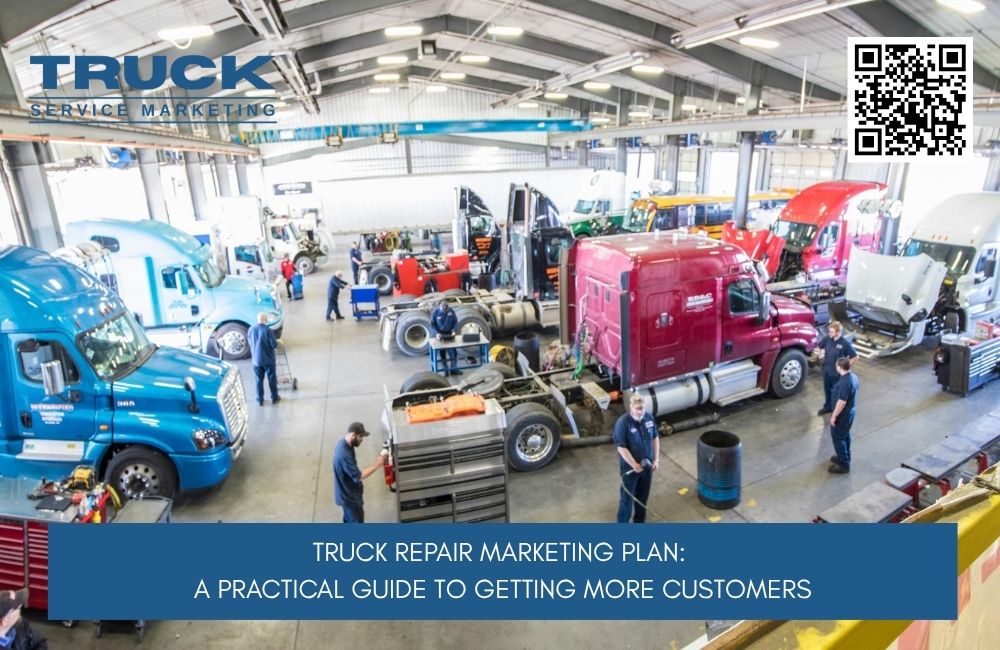
Truck Repair Marketing Plan: A Practical Guide to Getting More Customers
A good truck repair marketing plan should answer one question: where will your next profitable repair customers come from?
For a truck repair shop, the answer is rarely just one marketing channel. A steady flow of business can come from Google searches, Maps, referrals, fleet relationships, paid advertising, repeat customers, and people who find your shop while looking for a specific repair. The challenge is connecting those channels so they work toward the same goal.
A shop that handles semi-truck brake repairs may need a different marketing plan from a mobile diesel mechanic. A heavy-duty repair facility serving local fleets has different priorities from a company trying to generate leads across several states.
The best plan starts with the business itself. Identify the repairs you want more of, the customers you want to attract, the locations you can realistically serve, and the amount of work your technicians can handle. Then build the marketing around those priorities.
How Do You Create a Truck Repair Marketing Plan?
Start by deciding what you are trying to grow.
If your shop already has enough general repair work but wants more fleet accounts, your marketing should not simply chase more "truck repair" searches. You may need dedicated fleet service content, stronger commercial messaging, local outreach, and a website that explains how your business supports fleet operators.
If your bays are underutilized, the priority may be generating more owner-operator and local trucking company inquiries. If you specialize in transmission repair or diesel diagnostics, your strategy should make those specialties much easier to find.
This is the first major mistake many shops make with truck repair shop marketing. They start with marketing channels instead of business priorities.
Before spending money on advertising or producing dozens of pages, determine which services have capacity, which services are profitable, and which customers are worth attracting.
Who Should a Truck Repair Shop Try to Reach?
Truck repair customers are not all searching in the same way.
An owner-operator with a disabled semi may need an answer immediately. A fleet manager may be researching repair partners before a problem occurs. A local trucking company may need preventive maintenance on several vehicles. A driver may need emergency brake repair while traveling through the area.
That means marketing for truck repair shops needs to account for different buying situations.
Emergency repair searches often have very high urgency. A search such as "mobile diesel mechanic near me" may result in a phone call within minutes. Preventive maintenance searches can take longer because the customer has more time to compare options.
Fleet prospects may take even longer to convert, but a successful relationship can be more valuable than a one-time repair.
Your marketing plan should therefore have more than one path to conversion.
How Does SEO Fit Into a Truck Repair Marketing Plan?
SEO should help your shop become visible for the services and locations that matter to the business.
A strong truck company SEO marketing strategy starts with understanding how people search for your services. "Truck repair" is only one possibility. Customers may search for "heavy-duty brake repair," "semi truck transmission repair," "diesel engine diagnostics," "trailer repair," or "fleet maintenance service."
Each search represents a different need.
A dedicated service page gives you the opportunity to answer that specific need. Someone looking for transmission repair should not have to search through a general truck repair page to find out whether you offer the service.
The same principle applies to location targeting. A repair shop in Houston should make its service area clear, while a mobile mechanic may need to communicate a much wider coverage area.
For businesses that want to build this foundation, a dedicated Truck Repair SEO strategy can connect service pages, local SEO, technical optimization, content, and authority building into one plan.
What Should a Truck Repair Website Include?
Your website should quickly answer the questions a potential customer is likely to have.
What types of trucks do you repair? Which services do you provide? Where do you operate? Can customers bring vehicles to your facility? Do you offer mobile service? Do you handle emergency repairs? How can someone contact you?
These answers should not be buried.
A fleet manager evaluating your company should be able to understand your capabilities without making several phone calls. An owner-operator searching from a truck stop should be able to find your phone number immediately.
Service pages should also be specific. A page about diesel engine diagnostics should explain that service rather than simply repeating the phrase "truck repair" throughout the page.
Your website is where truck mechanic marketing turns search visibility into an opportunity to generate business.
Should Truck Repair Shops Use Google Ads?
Google Ads can be useful when a shop needs to generate demand quickly or wants additional visibility for valuable services.
For example, a business specializing in emergency truck repair may want to appear when someone searches for immediate assistance. A transmission specialist may use paid search to reach customers actively looking for heavy-duty transmission repair.
The important part is targeting the right searches and sending those customers to relevant pages.
A campaign for "mobile truck repair" should ideally lead to a page about mobile truck repair. An advertisement for fleet maintenance should lead to information written for fleet operators.
This is where truck repair marketing services should work together rather than operate independently. Advertising, SEO, website design, landing pages, tracking, and follow-up all affect the final result.
For a shop that needs help managing these channels together, working with a specialized truck repair marketing agency can make sense, particularly when the business does not have the time or internal resources to manage campaigns consistently.
How Much Should a Truck Repair Shop Spend on Marketing?
There is no single marketing budget that works for every truck repair business.
A reasonable budget depends on your average job value, margins, available capacity, competition, service area, and growth goals. A shop with several empty bays may have a strong reason to invest more aggressively in lead generation. A shop already booked several weeks out may need to focus on higher-value services rather than simply increasing lead volume.
Consider the difference between a one-time brake repair and a fleet maintenance relationship. The first customer may produce one job. The second could produce recurring work over a much longer period.
Advertising costs also vary significantly by market and keyword. Competitive metropolitan areas can behave very differently from smaller markets.
Instead of asking only, "How much should I spend?" ask, "How much can I reasonably spend to acquire a qualified customer while remaining profitable?"
That question produces a much more useful marketing budget.
How Should Local and National Marketing Differ?
A local truck repair shop should concentrate heavily on its geographic market.
Google Maps visibility, the Google Business Profile, local reviews, service-area information, citations, location pages, and geographically targeted advertising can all support this strategy.
A company serving customers nationally needs a different structure.
National SEO should focus on services, industries, equipment types, problems, and broader commercial searches. Simply creating hundreds of city pages is not a substitute for a genuine national strategy.
For example, a company specializing in fleet maintenance across multiple states may create useful resources around preventive maintenance programs, heavy-duty diagnostics, fleet service, and commercial truck repair.
Location should support the actual business operation. If technicians do not travel to a particular city, marketing the company as a local provider there can create poor leads and damage customer trust.
How Can a Diesel Repair Business Generate More Leads?
A diesel repair business should market the problems and services it is equipped to solve.
A customer searching for "diesel mechanic" has provided some information. A customer searching for "diesel engine diagnostics near me" or "DPF repair for semi truck" has provided much more.
That makes specific service and problem-focused content valuable.
A diesel repair shop might build content around engine diagnostics, injector problems, DPF service, cooling system repairs, electrical diagnostics, or preventive maintenance. These pages can then support both organic search and paid advertising.
The same approach works for heavy-duty repair. If brake repair is a major revenue source, the website should clearly explain heavy-duty brake service. If trailer repair is an important service, it deserves dedicated content rather than a passing mention on a general services page.
How Should You Market to Fleet Operators?
Fleet marketing requires patience because fleet managers are not always searching for a repair shop during an emergency.
They are often evaluating reliability, coverage, capabilities, communication, scheduling, and long-term service relationships.
Your website should make those capabilities clear.
A fleet-focused page could explain preventive maintenance, recurring inspections, repair coordination, emergency support, vehicle types serviced, and geographic coverage. The objective is to show that your company can become part of a fleet's maintenance process rather than simply handle a single breakdown.
This is an important part of semi truck marketing because commercial customers often need a different message from individual drivers.
What Is the Best Step-by-Step Truck Repair Marketing Process?
The first step is to identify your highest-value services and the customers you want to attract.
Next, examine how those customers search. Look for service terms, problem-based searches, emergency searches, and location-specific phrases.
Then organize the website around those priorities. Create strong service pages and make important contact information easy to find.
After that, improve your local presence if you serve a defined geographic market. Your Google Business Profile, website, reviews, and location information should all accurately represent the business.
The next stage is building authority and useful content. Answer questions customers actually ask about diesel repair, truck maintenance, emergency service, brake problems, diagnostics, and fleet maintenance.
Once the foundation is in place, use Google Ads strategically for high-intent searches where additional visibility can produce worthwhile leads.
Finally, measure the results. Track calls, forms, qualified inquiries, booked jobs, lead sources, and the services those leads are requesting.
The strategy should change based on what the data shows.
What Metrics Matter Most in Truck Repair Marketing?
Traffic and rankings are useful, but they are not the final measurement.
A repair shop should know how many calls its website generates, how many of those calls are qualified, how many become appointments, and which marketing channels produce those inquiries.
For example, ranking highly for a general informational search may produce traffic but little business. A lower-volume page about emergency diesel repair could produce fewer visitors but significantly more calls from people who need service.
That is why lead quality matters.
A marketing plan should also distinguish between one-time repair leads and potential fleet accounts. Both are valuable, but they should not necessarily be evaluated in exactly the same way.
What Are the Biggest Truck Repair Marketing Mistakes?
One of the most common mistakes is trying to promote everything at once.
A shop may offer dozens of services, but its marketing budget should usually prioritize the services that matter most to revenue and capacity.
Another mistake is relying entirely on referrals while having little online visibility. Referrals are valuable, but they do not help much when a new customer who has never heard of your shop searches Google and finds a competitor instead.
Poor follow-up is another problem. A marketing campaign can generate a qualified lead, but if nobody answers the phone or responds promptly to an inquiry, the marketing investment can be wasted.
Finally, avoid judging success by traffic alone. More visitors do not automatically mean more repair jobs.
Frequently Asked Questions About Truck Repair Marketing Plans
How do I market a truck repair shop?
Start with your highest-value services, identify the customers you want more of, and build your website and marketing around the searches those customers use. Local SEO, service-specific SEO, Google Ads, reviews, referrals, and fleet outreach can all play a role.
What is the best marketing strategy for a truck repair shop?
There is no single strategy that fits every shop. A local repair facility may prioritize Google Maps and local SEO, while a mobile mechanic may focus on service-area searches and emergency leads. A fleet specialist may put more resources into commercial-focused content and relationship building.
Should a truck repair shop hire a marketing agency?
It can make sense when the owner or management team does not have the time to consistently handle SEO, advertising, website optimization, content, tracking, and lead follow-up. A specialized agency can also help coordinate those activities into one strategy.
How do I know if my marketing is working?
Track qualified calls, forms, appointments, repair jobs, cost per lead, and lead source. Rankings and website traffic can help explain performance, but the ultimate question is whether marketing is producing the right customers.
How Can You Build a Truck Repair Marketing Plan That Actually Works?
A useful how to market truck repair strategy starts with the business, not the marketing platform.
Know which repairs you want more of. Know which customers are most valuable. Know where you can provide service. Then build your website, SEO, Google presence, advertising, and customer follow-up around those realities.
A shop specializing in emergency diesel repair should not market itself exactly like a facility focused on scheduled fleet maintenance. A mobile mechanic should not use the same location strategy as a fixed repair shop. A company pursuing national fleet accounts needs a different approach from a neighborhood heavy-duty repair facility.
That is what makes a strong truck repair marketing plan practical. It connects marketing activity to actual shop capacity, customer demand, and business goals.
If you want to attract more qualified truck repair customers, start by identifying the services and markets where you have the greatest opportunity. From there, a focused combination of SEO, local search, paid advertising, content, reputation building, and lead tracking can turn your online presence into a much more consistent source of repair business.
